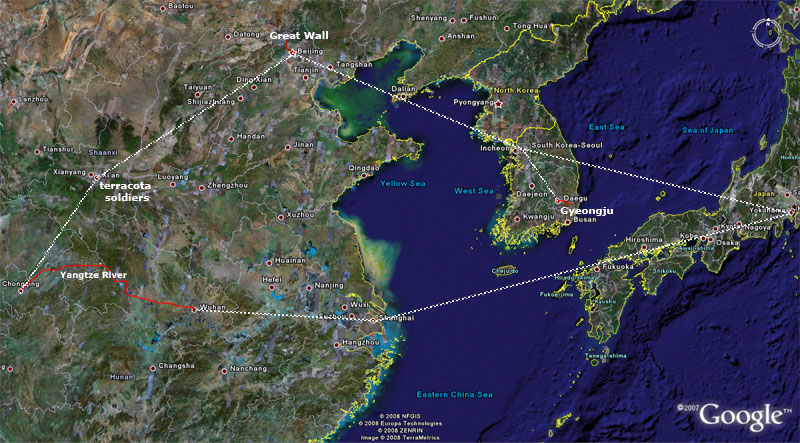
Barbara writes a story of our trip ... with links to pages with
photos:
We were lucky to be there when we were.
Very few foreign tourists !!!!
Either the earthquake, the floods, the difficulty in getting visas,
the hotel prices running up to the Olympics – something seemed to keep
foreign tourists away (at least the Americans).
South Korea was pleasant, manageable, not overly hot, and occasionally
sunny. It seemed to me more
spoke English in South
Korea
than China.
But that might have been because we had David and Brie with us….it
was easy – we had our own, favorite tour guides.
China
was mostly hot and humid, but no “whitey’s” to speak of. Only once did
we encounter a blue sky in
China
– it varied from grey (indistinguishably fog or pollution) to mist, to rain.
Temperatures varied from 70 to 90 degrees along the trip.
The food was great. It is
an incredible country, going somewhere, fast, but where and when, I don’t
know. I am so glad I saw it, but
do I need to see it again – probably not.
It is one unfathomably huge city after another.
They make a joke that the country’s national bird is the crane – but a
construction crane is what they mean.
Seoul & Daegu
-
Seoul
was a pleasant, cosmopolitan city.
Large, busy and our hotel, in Itaewon, overlooked the
Han River
and the newer part of town. In
the morning we wandered down to “town”, but it was sleepy – so waited for
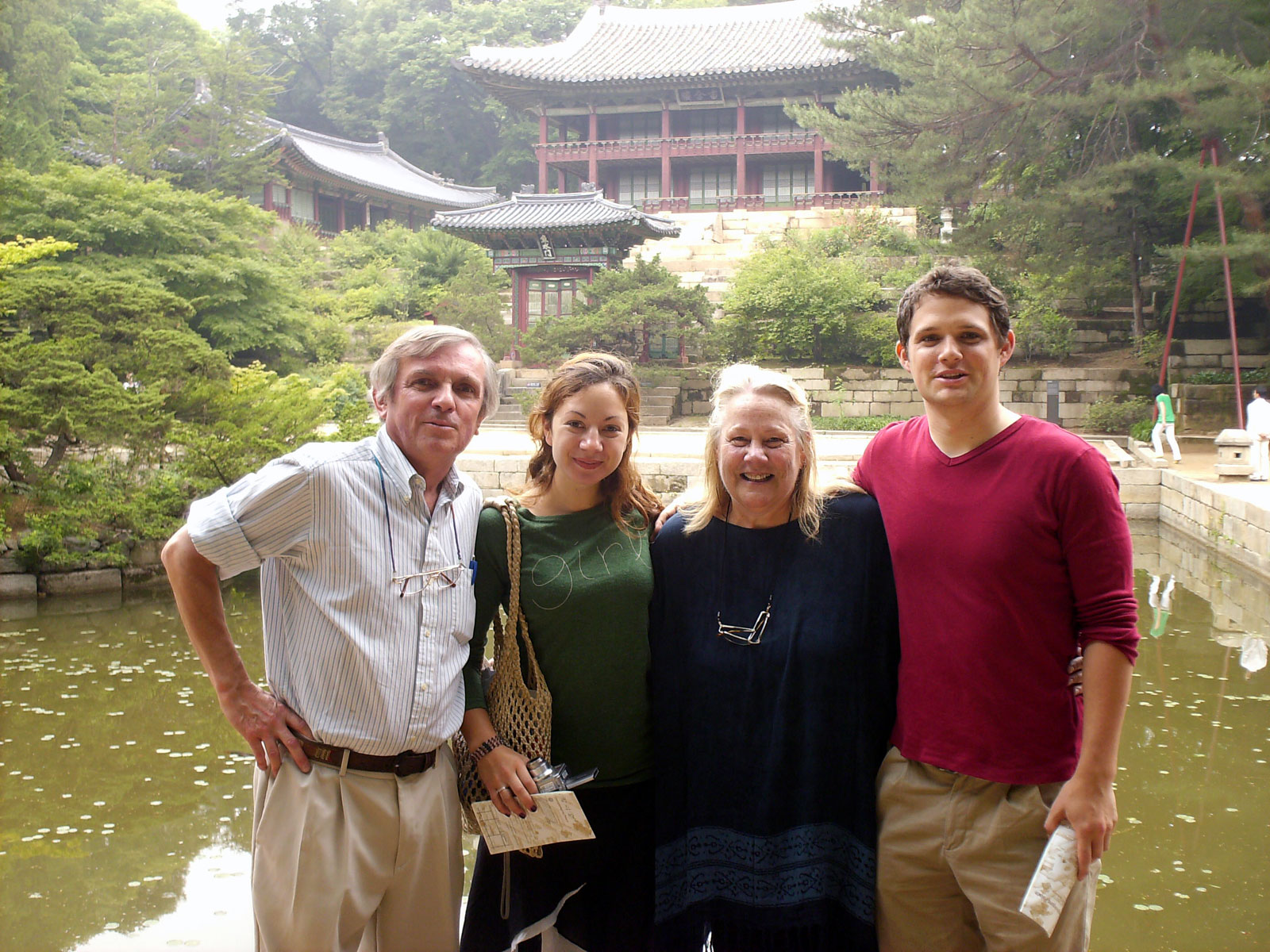
David and Brie - then took a guided tour through Changdeokgung Palace
– for our first glimpse of pagodas – and a “Secret Garden”
- a wonderfully mellow park with lots of water everywhere.
It seems like we ate a lot of strange things – something we would not
have done on our own. Of course,
every meal included kimchi – that rotten cabbage, which I eventually found I
liked – especially with grilled meats.
That afternoon we saw a funny little musical (in Korean – so we only
thought we knew what was going on), then went around town looking for a
place to eat grilled meat – slices of beef that we cut with scissors, placed
on a wire basket over charcoal with a big fan sucking up the smoke – wrapped
the grilled meat, grilled kimchi, grilled garlic and other “condiments” in
lettuce and sesame leaves, then grilled more and repeated the process.
The next day we saw the changing of the guards at
Deoksugung
Palace.
On the way there we got glimpses of the police getting ready for
protests that eventually, a week later, ended up with thousands uprising
against “American Beef” and a complete change of government ministers.
A relatively high-speed train ride past field upon field of
rice-paddies that afternoon took us to Daegu.
This was another cosmopolitan town where David has been teaching
English to kids for the last year.
Our hotel seemed like a little Versailles – gold leaf, TV in the
bathroom, and high-speed internet connection.
Instead of going out, we had a dinner in the hotel that night with
David and Brie – due to a downpour and a little weariness.
The following morning, Tom and I got up early, walked to
Duryu
Amusement Park and
ascended a TV tower, with toilets that featured a view of Daegu.
After that, we met David – visited his apartment and his hapkido
class – then to his school to meet his Korean colleagues; we met Brie took a
bus ride to Palgongsan Park, a very interesting meal of noodles, soup, tofu
and kimchi (again), a cable car ride to the top peak – and that night joined
Doug (David’s roommate the first year at the University of Rochester) for a
meal of grilled bacon and kimchi (and again).
Whew….the food….
The four of us set off to AVIS the next morning for our rental
car for an hour-long drive outside the city to Gyeongju – a smaller town of
about 300,000 – called the “museum without walls” – previously the capital
of the Shilla dynasty that lasted from 57 BC to about 1,000 AD.
Only to find out that we needed international driving licenses – that
we did not have !! Since, our
reservation made no mention of this requirement, AVIS finally agreed to pay
for a driver – and we were on our way.
What a lovely place.
First a hike up the hill, past people selling grilled larvae, across
beautiful bridges, past ugly, monstrous dragon-like carvings, and into the
Bulguksa Temple with beautifully painted ceilings; then level upon level of
more pagodas, each with their own Buddha’s, the last with wishing stones.
Saying goodbye to Brie (who had to teach), after another interesting
meal, we took a short drive to the peak to the Seogulam Grotto with a giant,
granite Buddha and a thousand Korean school children; then on to the
National Museum, with artifacts from various tombs found in the area – and
still being unearthed. That night, a fancy Italian dinner (finally no kimchi)
with David, and we said goodbye until later this year.
Our flight to Beijing left early the
next morning without a hitch. See
photos of Seoul, photos of
Daegu and Gyeongju, or click the arrow to go
back to the top of the page.

Beijing
- I liked Beijing much better than Shanghai. I just
hope they can someday clean up the pollution (and I'm not entirely hopeful
for the Olympics end-date).
On arriving, we lucked out incredibly to find a fantastic,
non-touristy, family restaurant two blocks from our hotel (great food that
the waitress warned was too spicy – but we loved it), encountered students
in calligraphy and art that we were later warned about, and started the
first afternoon wandering around the outside of the Forbidden City (I hope
some day, some one can tell me what was really behind those red velvet
curtains that were only reserved for the locals). The hugeness of Tian’an
Men Square with guards all around and communist-style buildings on either
side just completed my remembrance of the students who started to "free"
communism. Then we set off to walk to the Temple of Heaven – but not
realizing how large were their “blocks“ – caved in to a rickshaw driver who
would shorten our trip for 3 Yuan – who ended up stopping after a quick trip
through some run-down hutongs (one-story neighborhoods) - only to demand 300
Yuan. We paid him 7 Yuan and
looked for the closest policeman.
At that point my poor feet had enough and we found a taxi to return
to our hotel. That night we saw
one of the “famous” acrobatic performances – taking nearly an hour to travel
10 blocks – traffic lights stopped for a full 10 minutes in each direction
!!!! Office buildings were huge,
spectacular - some empty, more being built – just the overwhelming size of
them and it all, was tough to take in.
On the way home, we had trouble communicating with a taxi driver that
we wanted to return to our hotel – so when he finally stopped – we thought
we were miles from our destination and furious, did not pay him - only to
find out we were a block from our hotel, wandered through the night food
court, and then home for a well-deserved rest.
Setting out the next morning for the
Forbidden City – we encountered again the students in
calligraphy – but were wiser this day not to be taken in.
I loved the temples, the myriad of roofs descending into one another
– all at different angles, I can’t wait to watch “The Last Emperor” once
again, and just the hugeness of the Forbidden City.
This was our first encounter with guide tapes that started playing
when you arrived at a certain location without you putting in numbers that
we used throughout the other temples. By taxi this time, on to the Temple of Heaven
built with no nails - an incredibly beautiful Ming structure, inside and out
– perfect blue and gold combination.
The park there was lovely - running into a "spontaneous" group of
Chinese singing a capella, another of men and women dancing to music from a
boom-box, waving crepe dragons, doing tai ji, a guitarist under a tree
playing a one-stringed instrument that was haunting, ladies walking arm in
arm, music floating throughout the park (skillfully hidden in light posts).
A few hours later – we found our way to a great
Sichuan
restaurant on Lake Qian Hai - a restaurant that we returned to again two
days later. This led to an
unexpected trip via a fancy, legitimate rickshaw, through a semi-restored
hutong, and a “soho-type”, young, shopping neighborhood near there.
The hutongs in that section of town that are slowly being restored
reminded me of Park Slope in Brooklyn
– in a few years they will be worth a fortune.
Later that night, after looking on the internet for prices, we
shopped for a camera (more expensive than Amazon even after intense haggling
– but I needed a new one), visited
St. Joseph’s church (without one mention anywhere
that it was Catholic), and returned to our original “family” restaurant for
some more spicy cuisine.
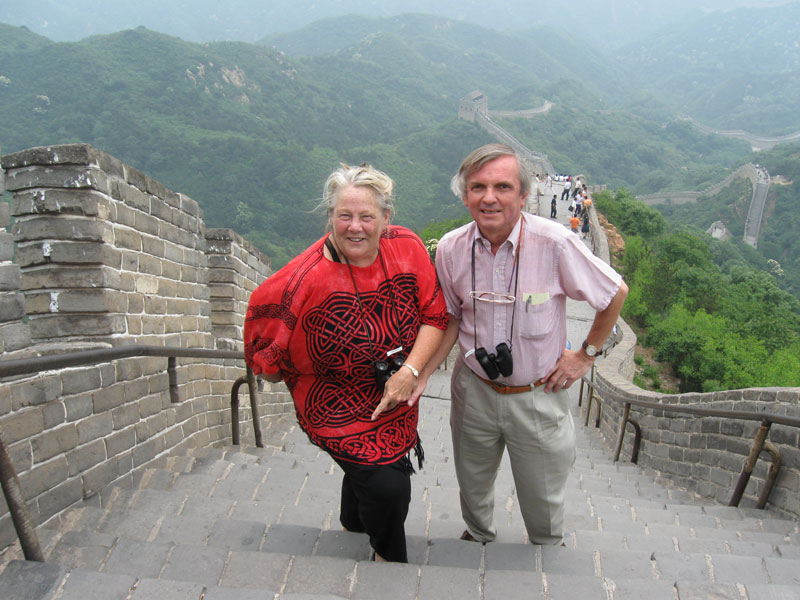
Our trip the next day to the Great Wall with Sandra, our guide,
was uneventful with the exception of 16 wheelers belching horrible fumes.
The odor north of the city on the way to the Great Wall was "deja vu"
the 9/11 smell we lived with in Downtown Manhattan for many months.
Hundreds, maybe thousands, of Chinese tourists were enjoying the wall
from every angle and we were repeatedly stopped to have pictures taken with
them and their families – the strange gringos!!!
Slightly cloudy or polluted (I would imagine the latter) – with
binoculars, we could barely see the Wall disappear in the distance down one
hill, to the next, areas collapsed that seemed miles away – like a snake
wandering aimlessly, but with purpose. We skipped the silk and pearl
markets and opted instead for Jade and Cloisonné factories – both very
interesting. Our guide, Sandra,
was proficient, proud of being Catholic (the only guide we had that declared
a religion), and happy to use her English Lit major to be a tour guide
rather than a teacher (I can understand that).
On our own the next day, originally intending to visit the Old
Summer
Palace – but since it was
raining – instead we donned parkas and found a taxi to take us to some
temples. The lovely driver
offered to spend the day with us, driving, for 400 Yuan ($60) – we first
went to the "Bird's Nest", the new 2008 Olympic Stadium, then to the the Lama Temple with its 57-foot Buddha carved from one piece of wood and
incense burning in the rain, the Confucius Temple and Imperial College with
monstrous stone tablet-turtle dragons carved with names of those passing the
civil service exams. We stopped
for lunch on the lake, bought some shoes at a store recommended by our taxi
driver and returned home. The
parks, the temples, the lakes, the taxis, the rickshaws, the food, a one-day
laundry (saved a lot of money in there!) – it was all great.
See photos of Beijing, photos of
the Great Wall, or click the arrow to go
back to the top of the page.

Xi’an
– The next morning – a minor delay.
The first flight (ours) to Xian was cancelled and combined with a
later flight – we just weren’t horribly sure we had a seat – and only at
long last found one young man who spoke English at the airport.
He assured us, with no paperwork, that all would be fine.
It was, we got on the flight, and were deposited in Xi’an, only 3 or 4 hours late.
That first night, upon the advice of our local guide, Christine
(major in Chinese History), we were typical tourists at a theatre with 20
kinds of dumplings and a show…along with French, Germans, Swiss…but very few
Americans – I think the whole tourist population ended up there that night.
With Christine and our driver, the next morning we set out to see
The Warriors – well what can I say? Phenomenal
and beyond comprehension or imagination - it is really hard to envision
these soldiers without seeing them.
Again, the food was fantastic at a one local restaurant for lunch on
the way home from the warriors – really hot and spicy – and the best green
beans we’ve had anywhere and strange little buns in which we inserted a pork
concoction! Then the city wall -
18 meters wide – if we ever return – we will take the time to bike the whole 9
miles around it, the Great Goose Pagoda – beautiful in its simplicity with
its big laughing Buddha; and the Bell Tower - great at night and we lucked
into a musical performance with the oddest of instruments – a mouth organ,
bells and jade stones cut for individual tones.
I regret not having time to visit the Great Mosque and the local
cuisine – a few of our shipmates on the cruise said the food was great there
also. At this point I began to
realize that all the cities we would visit would be huge, under
construction, and still growing…..
See photos of X'ian, or click the arrow to go
back to the top of the page.

Chongqing
– Sherri, majoring in tourism, led us through this city after picking us up
from our flight the next day.
Had this city been cleaner and more compact – it would have been
Hong Kong. Nestled
(if you can call 13 million nestling) on all 4 sides of the conjunction of
two rivers – the Jialing
and Yangtze – and a peninsula in between - it had no bikes or mopeds due to
its hills. Having only one
bridge built in 1966 and now 30 in 2008 – made us wonder whether Manhattan will ever get its act in gear.
This was the hottest in temperature that we encountered – about 33 C
or 91 F – and also relatively polluted air – with cranes everywhere – and
high-rise apartments as far as the eye could see - this was where I started
going through tissue after tissue, and being able to wring them out only for
use again.
First to the zoo to
see pandas munching on bamboo; then we had one of our most memorable meals.
We were glad we were not tempted into “hot pot” before – Chongqings’
is famous. A large bowl divided
in two in the shape of ying-yang – one side no spices, the other side spices
– sitting on a propane-fired grill in the middle of the table.
We started out using both sides – but segued into just the spicy side
– and it got spicier and spicier as the broth cooked!!!
- thinly shaved meats, sausages, fungi, mushrooms, rice noodles, flat
tofu noodles, lotus root, bok choy, pasta dumplings, fake crab.
We were almost the only ones there – and it was air-conditioned, but
to no avail for me.
After that
we visited CiqiKou Ancient Town
– my idea of China
– narrow streets, strange (some awful) smells, tea houses, pagodas,
grey-tiled roofs, and scores of shops selling everything a tourist could
desire. Tom climbed the pagoda
with a view of Chongqing – but I
declined….too many steep steps for my ski-knee!
Then on to a museum/art museum with a 150-foot long painting of the Yangtzee River before it was flooded – what a
great perspective of what we were next to enjoy.
On to our cruise ship and air-conditioning at last – little porters
with the typical pole carrying two swinging bags and muscular calves!
That night we left the harbor directly across from the new opera
house that is being built – which will some day be one of the most beautiful
in the world. At the conjunction
of the two rivers in the shape of a space ship – in the hugest of
proportions – it should serve this 31 million-strong municipality very well.
The harbor was a collage of brightly lit structures with a departing
light show at 9:00 pm.
See photos of Chongqing, or click the arrow to go
back to the top of the page.

Yangtze
River Cruise. Had we done this on
9/11 (2001) as were supposed to have done, we would have seen this valley
being reconstructed to move its inhabitants 500 feet up its river banks in
preparation for the flooding, done in 2 stages in 2004 and 2006, then the
final stage projected for 2009.
Originally envisioned in 1919 by Sun Yat-sen (the name of Jenny’s middle
school in Manhattan), planned by
Chiang Kai-shek, supported by Mao Zedong (the inspiration for which is now
claimed by him), it was formally approved in 1992 and construction began in
1994. At every stop on our
cruise we talked to our assigned guides – who lived in the local town where
each stop took place – and questioned how they felt about the relocation.
One young man put it bluntly: his family of 9 (grandparents, parents,
brother and wife, he, his wife and child) was living in an adobe-like house
with 700 sq ft; they are now living in 3 separate apartments with over 3,500
sq ft. The younger generation
loves it – the older generation lost their fields, their ancestral tombs,
and their trek to work is now to allocated plots, in less fertile terrain,
higher up the hills. Obviously
the food on the cruise was nothing to speak about – and thank god Tom bought
water and beer in town before we left – each drink was more than 3 dollars
regardless of what type!!
The first morning we had relatively clear blue skies and visited
Fengdu – the Tang
Dynasty
Pagoda
Temple to the City of the
Ghosts. Forgoing the walk up and
using the cable car instead, we swung through the “rain forest” to a
pagoda-temple on top of the hill with statues of every then-known sin,
horrific, tortuous, sexual and just plain ugly.
A deep color blue was used everywhere to signify the sky and it was
quite beautiful. We chose a
wish-bridge to walk over – either health, wealth, or to return married to
the same person – and tried to balance on one-foot on a rounded stone for 3
seconds to obtain good luck.
The second morning we arrived at the first Gorge – Qutang.
Later, at Wushan,
we left the ship, boarded a smaller ship that traveled up the
“Mini Three Gorges” with hanging coffins (the belief was that the higher
your coffin, the closer to heaven) and steep mountains on either side.
All along the way there were markers of the eventual flood level –
another 35 meters higher (the river had recently been disgorged 10 meters
for this season’s potential flooding). We saw islands that had already been
created which would eventually disappear completely, the last remaining
vestige of one tracker path used to haul boats up the gorge where the river
used to be too low to navigate, new bridges being built 300 feet above us.
We then separated into even-smaller boats of about 30 each and
traveled a smaller gorge – with stone cave houses with families who sang
folk songs to us. We were very
lucky. Evidently we were only
about 500 visitors that day – where up to 10,000 tourists can be handled on
any one day !!!! We continued
downstream in ever more foggy mist and occasional rain toward the second and
far steeper stretches of hillsides and tributaries, each with a new bridge
recently built or in progress.
It was quite awesome and ghostly and very green.
We reached the second gorge – Wu, with its sharp, jagged peaks, the “Goddess Peak”
– which will someday disappear because it looks incredibly fragile way up
there. Eventually we reached the
final gorge - Xiling – and soon thereafter entered the locks of the Three
Gorges Dam. Here we were
transported through 4 stages of the eventual 5 locks – down some 450 feet in
depth over a period of 3 hours.
It was quite impressive – these huge doors opening, the cruise ship
positioning itself side-by-side with a coal barge, behind two sets of two
other freight barges – six ships, moving in tandem down a man-made channel
that consumed an unimaginable amount of concrete and steel – the doors
closing, the ship sinking – only to be repeated 3 more times.
And then we docked for the night at the base of the dam.
The third morning we awoke, took a trip by bus to the top of the
back of the dam in pure fog.
Security was tight. We could not
see from one end of the dam to the other because of the fog – but it was
more than a mile wide. Thank
goodness for a scale model.
There is no other word to describe it except - HUGE.
From there we traveled with David, our guide and another tourism
major, by car for 4 hours to
Wuhan.
See photos of the
Fengdu "City of Ghosts", the
Yangtze River, the
"Lesser Three Gorges"
and the Three Gorges Dam, or click the arrow to go
back to the top of the page.

Wuhan
– another large city which is a now a merger of three – Wuchang, Hanyang,
and Hankou. We drove for what
seemed like miles from the start to the center of the city.
That night was only a stop on the way to
Shanghai.
We managed to get cash, wander through the night market which was very odd
and included store-front bordello’s, after which we ate in a spectacular
4,000-seat, 4-floor restaurant where one area was Korean and the other
Chinese – we stumbled into the Korean side and with aid of the waiter had a
delicious dinner that we grilled at our own table.
The next morning we got up early, found a taxi and had him drive us
to Mao’s villa - obviously not visited by many, because the taxi driver had
never been there – so he joined us in visiting a very modest villa; from
there to an aviary with a parrot show (next to a Disneyland of sorts), and
back to our hotel for an 11:00 am flight to Shanghai, facilitated by
Becky.
See photos of Wuhan, or click the arrow to go
back to the top of the page.

Shanghai –
Perhaps considered by some as the pearl of Asia - I think it is only a city
now striving to be bigger and better than New York City and Hong Kong - but
just dirtier. Granted, it does
use a hell of a lot of electricity to keep its colorful buildings alight at
night, and its subways and trains are clean and efficient and can be easily
traveled due to a common numbering system, since there is very little
English. Maybe it was that I
already had my fill of temples, large, monstrous buildings and apartments,
cranes, hawkers, and shopping – or it could have just been the rainy
weather, the humidity or that I longed for my own bed in Antigua.
Lemon met us at the airport and we all proceeded into Shanghai
using the Maglev train which only traveled at a disappointing 300 km – 200
mph – instead of 300 mph – and our taxi met us there with our suitcases from
the plane to drive from Pudong to our hotel on People’s Square.
Tom found a laundry – we’d run out of most clothes – and we ventured
out to the Nanjing
shopping street for dinner. Why
they all thought I wanted Rolexes, dvd’s, Nike’s – I don’t know – but I
guess because I was one of very few Americans. A nice little tea house with
OK food. The next day we
ventured to the subway to the train station to buy tickets for Monday to Suzhou, a town about 45 minutes by train
outside of Shanghai. That done,
we came back to the Bund – but it was dowdy in the midst of a subway
reconstruction and rain - to maybe book a night dinner cruise – but it was
so foggy we decided to wait until later – and well we should, because it
poured. Then off to Yu Gardens
and Bazaar – probably a lovely, quaint place without people – but it was so
crowded on Sunday. We were told
to bargain furiously – and things that started 480 Yuan eventually became 40
Yuan !!!! We did have a very
good meal in a restaurant that boasted a visit by Bill Clinton – and
encountered a family with 4 children - their fines must have steep but they
were obviously wealthy - the father wore quite a lot of gold, the mother got
the air conditioning turned off (much to my horror).
See photos of Shanghai, or click the arrow to go
back to the top of the page.

Suzhou -
The next day we got up early and took the subway to the train and
visited Suzhou – a town of canals and gardens.
It was lovely, despite the rain.
The gardens were the prettiest yet.
First the Master of the Nets Garden,
relatively modest – then the Humble Administrator’s Garden – magnificent !!!
We ran into a tour with Costa Ricans and Guatemalans with a tour
guide who spoke English. This
administrator must have come by his funds strangely – for after being fired
from his job for incompetence, he built the most beautiful garden we’d seen
yet. Deciding on lunch after
that became a problem – since most restaurants had already closed – but we
managed to convey to taxi driver by hand signals that we wanted to eat,
found a hotel that still served food, delighted two waitresses who had never
encountered Americans, giggled and who had never seen a tip!
They tried to give the “extra” money back to us but were just so
delighted when we left it with them.
After that, the Silk Museum
– how in the world did anyone decide that cocoons could be made into
fabric?. Then back to our train,
to the subway, to our hotel, and a fancy Italian dinner to say goodbye to China.
Lemon picked us up the following morning and continued to divulge a
myriad of facts about Shanghai, her family history – a grandfather
who had been a professor at a private university who lost his job to the
Communists. She was a walking
encyclopedia – we could have asked her any question, and she would have
known the answer.
See photos of Suzhou, or click the arrow to go
back to the top of the page.

The rest is history – Shanghai, Narita, Dallas,
Guatemala –
"East - West, Home is Best" ……..